Introduction
Moving heavy items by hand wastes time and energy. A Hand Trolley offers a simple solution for transporting boxes, appliances, and equipment with less effort. It is widely used in warehouses, delivery services, retail stores, and homes. When used correctly, it improves efficiency and reduces physical strain. In this article, you will learn how to use a Hand Trolley properly, including loading methods, balance techniques, and safe movement practices for smoother and more reliable material handling.
Understanding What a Hand Trolley Is and How It Works
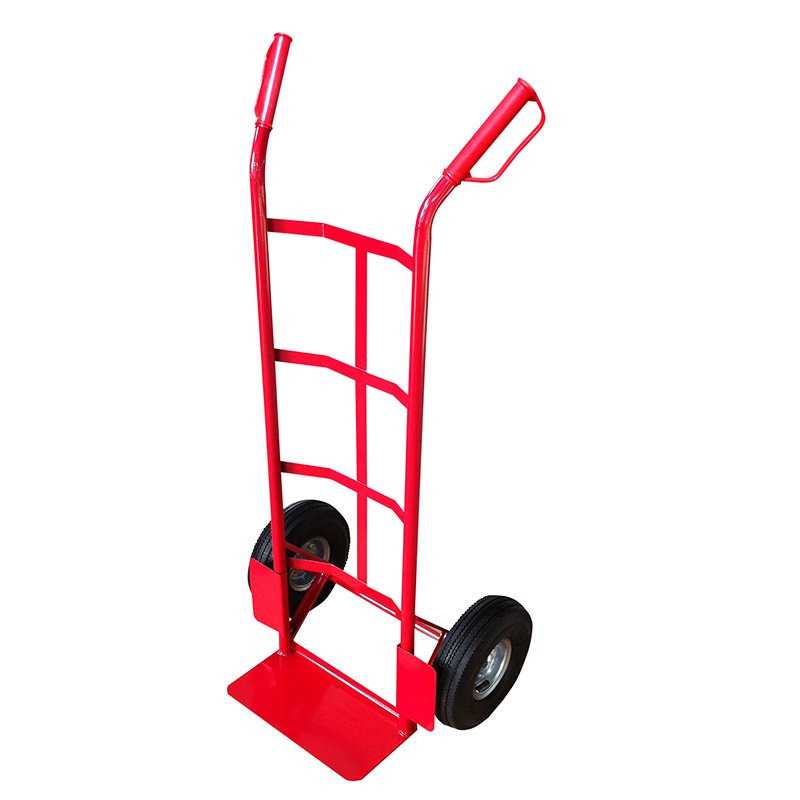
Basic Structure of a Hand Trolley
Beyond the main components, modern Hand Trolleys often include reinforced steel tubing, anti-slip handle grips, and precision bearings inside the wheels. These features improve durability and reduce rolling resistance. Many industrial models use powder-coated steel frames for corrosion protection and long service life. The toe plate may also feature ribbed or textured surfaces that increase friction between the load and the platform. This structural design helps maintain load stability and improves handling efficiency in warehouses, delivery operations, and manufacturing facilities.
How a Hand Trolley Uses Leverage to Move Heavy Items
The mechanical advantage of a Hand Trolley depends on lever geometry and wheel placement. When the load is tilted, the wheel axle becomes the pivot point and shortens the effort arm required by the operator. This reduces the lifting force needed to move heavy objects. Larger wheels further improve leverage by reducing rolling resistance and enabling smoother movement across uneven floors. Proper tilting angle usually ranges between 30° and 45°, which keeps the center of gravity above the axle for balanced movement.
Common Tasks a Hand Trolley Is Used For
In logistics and industrial settings, Hand Trolleys support multiple material-handling tasks beyond simple box movement. They assist in loading delivery trucks, repositioning machinery parts, and transporting supplies across production lines. Retail stores use them to move inventory from storage areas to display floors. In construction sites, workers transport tools, cement bags, or packaged materials. Because the equipment requires minimal training and occupies little storage space, it remains one of the most practical manual transport tools in modern operations.
Step-by-Step Guide on How To Use a Hand Trolley
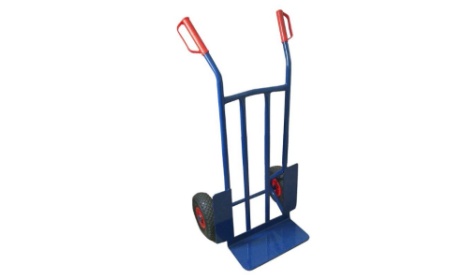
Step 1 – Position the Hand Trolley Correctly Under the Load
Proper positioning determines whether the load remains stable during movement. Before sliding the toe plate under the object, ensure the surface around the load is clear so the trolley can align straight with the center of mass. The toe plate should extend fully beneath the load so the contact area supports most of the base. If the object is tall or heavy, slightly tilt the item forward to help the plate slide underneath smoothly. Correct alignment distributes weight evenly across the frame and wheels, reducing the risk of shifting during transport.
Step 2 – Tilt and Balance the Load on the Wheels
Balancing the load is essential for efficient control of the Hand Trolley. When tilting the trolley backward, the operator should use leg strength rather than pulling with the arms alone. A moderate tilt angle typically allows the center of gravity to move directly above the wheel axle, which reduces the force needed to hold the load. Maintaining this balanced position prevents excessive strain on the operator and improves steering control. The goal is to let the wheels support most of the weight while the operator guides direction and stability.
Step 3 – Move the Hand Trolley Smoothly and Efficiently
Smooth movement helps maintain load stability and reduces operator fatigue. When pushing a Hand Trolley, keep a consistent walking speed and maintain a slight forward lean to guide the trolley naturally. Sudden acceleration or sharp turns can cause the load to shift and affect balance. When crossing thresholds, ramps, or uneven floors, approach slowly and allow the wheels to roll over obstacles gradually. Maintaining steady motion allows the load to stay centered over the axle, ensuring controlled handling and safe transport throughout the route.
How To Load Items Properly on a Hand Trolley
Placing Heavy Items at the Bottom for Stability
Placing heavier items at the bottom of a Hand Trolley stack improves stability by lowering the overall center of gravity. When the weight is concentrated near the wheels and frame, the load becomes easier to balance during tilting and movement. Industrial handling guidelines often recommend keeping the heaviest portion of the load within the lower third of the trolley height. This distribution reduces torque on the handle and minimizes the risk of tipping. It also allows the operator to control the trolley with less physical effort while maintaining consistent balance.
Aligning and Stacking Boxes Correctly
Correct box alignment ensures that weight remains evenly distributed across the Hand Trolley frame. Boxes should be stacked so that their edges form a vertical column directly above the toe plate. This configuration keeps the load’s center line aligned with the trolley’s wheel axis, which improves steering stability. For mixed box sizes, larger cartons should form the base layer while smaller packages fill gaps on top to avoid shifting during transport. Maintaining square edges and tight contact between boxes helps prevent lateral movement and keeps the load compact.
Securing the Load with Straps or Bungee Cords
When transporting goods with a Hand Trolley, proper load securing prevents shifting, tipping, or vibration during movement. Straps and bungee cords are widely used because they stabilize cargo against the frame. Selecting the right securing method depends on load weight, size, and transport conditions.
| Securing Method | Typical Application | Key Technical Specifications | Installation Method | Safety Considerations | Recommended Use Cases |
| Ratchet Tie-Down Straps | Heavy appliances, industrial equipment, stacked cartons | Common width: 25–50 mm (1–2 in) polyester webbing; Working Load Limit (WLL): 300–1000 kg (660–2200 lb) depending on strap grade | Wrap strap around cargo and trolley frame; tighten using ratchet mechanism | Ensure hook points are secure; avoid twisting webbing | Refrigerators, washing machines, warehouse equipment |
| Cam Buckle Straps | Medium-weight boxes or packaged goods | Width typically 25 mm (1 in); WLL around 150–300 kg (330–660 lb) | Pull strap through cam buckle and tighten manually | Avoid over-tightening delicate packaging | Moving cartons, delivery parcels |
| Bungee Cords (Elastic Cords) | Light loads or irregularly shaped items | Diameter 6–10 mm elastic cord; length typically 0.6–1.2 m (24–48 in); stretch capacity about 100–120% of original length | Hook both ends to trolley frame or cargo handles | Inspect hooks for damage; avoid overstretching | Lightweight boxes, tools, retail goods |
| Cross-Strapping Method | Tall or unstable loads | Uses two straps crossing at 90° over cargo surface | Attach first strap horizontally, second vertically | Prevents lateral movement during transport | Tall box stacks, narrow loads |
| Vertical Frame Securing | Long or upright objects | One vertical strap aligned with trolley frame | Strap runs from top of load to lower frame section | Keeps load from sliding forward | Pipes, panels, or narrow furniture |
| Protective Edge Guards | Fragile surfaces under strap pressure | Plastic or rubber guards placed between strap and cargo | Position guard before tightening strap | Prevents compression damage to packaging | Electronics, painted appliances |
| Strap Anchor Points | Connection points for securing devices | Steel hook or loop attachment rated >500 kg load | Attach strap hooks to frame rails or axle supports | Ensure anchors are not bent or damaged | Industrial transport environments |
| Strap Material Types | Determines durability and load strength | Polyester webbing tensile strength >2000 kg for heavy-duty straps | Select strap material according to load weight | UV and abrasion resistance important | Outdoor transport or long-term use |
Tip:For tall loads on a Hand Trolley, use a cross-strapping technique with two straps. This method distributes tension across the cargo surface and greatly improves stability when moving across ramps or uneven floors.
Best Techniques for Moving Different Types of Items with a Hand Trolley
Moving Boxes and Packaged Goods
When transporting boxes with a Hand Trolley, weight distribution and stacking geometry play an important role in stability. Each carton should sit flat against the frame so the vertical load line stays aligned with the wheel axle. Warehousing practices often recommend keeping the stack height between chest and shoulder level to maintain clear forward visibility. If cartons vary in weight, the heavier ones should sit closest to the toe plate. Maintaining tight contact between boxes reduces vibration and shifting, which improves control when navigating corners or narrow warehouse aisles.
Transporting Appliances and Heavy Equipment
Appliances such as refrigerators or washing machines usually contain internal mechanical components that require stable handling. Before loading them onto a Hand Trolley, secure loose cords and remove detachable parts to prevent damage during transport. Position the toe plate under the rear base where structural support is strongest. Industrial moving guidelines also recommend securing the appliance with two straps—one near the center and one near the top—to stabilize vertical movement. Keeping the appliance slightly tilted toward the frame helps maintain balance while the wheels absorb most of the load weight.
Handling Large Furniture and Bulky Objects
Large furniture pieces often have uneven weight distribution and wide surfaces, which requires careful positioning on a Hand Trolley. Placing the furniture vertically increases the contact area between the object and the trolley frame, improving stability during movement. Items such as dressers or cabinets should also be emptied beforehand to reduce weight and internal shifting. Professional movers often use moving blankets or foam pads between the furniture and frame to prevent scratches. Maintaining steady movement and gradual turns helps keep the load balanced while navigating doorways or tight corridors.
How To Use a Hand Trolley on Stairs, Ramps, and Uneven Surfaces
Moving a Hand Trolley Up Stairs Safely
When transporting loads up stairs with a Hand Trolley, maintaining the correct body position is essential. Stand behind the trolley and keep your arms extended while allowing the wheels to rest against the stair edge. The lifting motion should come primarily from the legs rather than the back. Moving one step at a time allows the wheels to settle firmly before the next lift. For heavier loads, coordinating with a second person helps stabilize the front of the cargo and reduces the effort required to raise the trolley step by step.
Guiding a Hand Trolley Down Stairs with Control
When guiding a Hand Trolley down stairs, controlling the descent is more important than speed. The operator should remain above the load and hold the handle firmly while lowering the trolley one step at a time. Keeping the trolley tilted slightly toward the operator helps maintain balance as gravity pulls the load downward. Allow the wheels to contact each step gradually rather than letting them drop suddenly. Controlled movement prevents abrupt weight shifts and protects both the operator and the transported goods.
Navigating Ramps and Uneven Floors
Ramps and uneven floors introduce additional forces that can affect load stability. When pushing a Hand Trolley up a ramp, keep the load tilted slightly backward so the weight remains centered over the wheels. On downward slopes, maintain a firm grip and control speed to prevent acceleration caused by gravity. For rough or uneven surfaces, larger wheels and slower movement improve stability. Maintaining a consistent angle and steady pace helps keep the load balanced while reducing vibration and strain on the operator.
Practical Tips for Operating a Hand Trolley Efficiently
Keeping Proper Body Posture While Using a Hand Trolley
Maintaining correct body mechanics reduces fatigue and improves control when operating a Hand Trolley. The operator should keep the spine in a neutral position and engage leg muscles when tilting the load. Standing too far from the handle increases leverage on the lower back, so staying close to the trolley improves stability. Many ergonomics guidelines suggest keeping elbows slightly bent and shoulders relaxed while pushing. This posture allows smoother steering and better balance, especially when moving heavy loads over longer distances or through tight workspaces.
Choosing the Right Hand Trolley for the Job
Selecting the appropriate Hand Trolley depends on load weight, size, and working environment. Standard upright models are commonly used for cartons and general warehouse transport. Appliance trolleys include reinforced frames, stair glides, and built-in straps to stabilize heavy equipment. Convertible trolleys provide flexibility by switching between two-wheel vertical mode and four-wheel platform mode for larger loads. Wheel size and material also matter; pneumatic tires absorb vibration on rough surfaces, while solid rubber wheels provide durability for indoor industrial floors.
Planning Your Route Before Moving a Load
Efficient transport with a Hand Trolley begins with proper route assessment. Operators should evaluate floor conditions, ramp angles, doorway widths, and potential traffic in the workspace. Industrial safety practices often recommend ensuring at least one meter of clearance around the load during movement. Checking lighting conditions and identifying uneven surfaces beforehand also reduces the risk of sudden stops. By planning a clear and direct path, operators can maintain steady movement, improve productivity, and minimize the chance of load instability during transport.
Safety Practices When Using a Hand Trolley
Checking the Hand Trolley Before Each Use
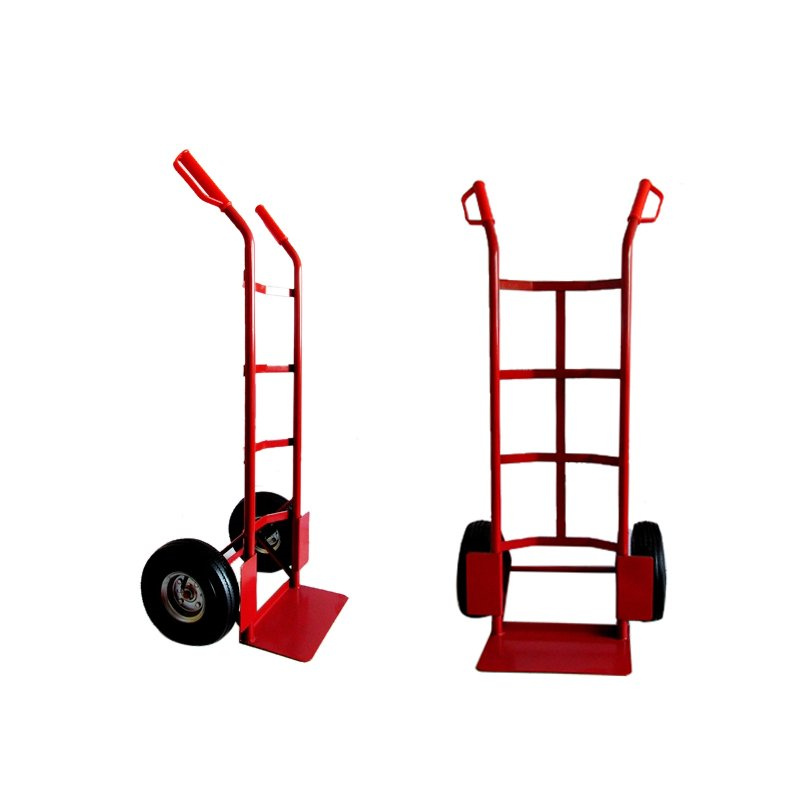
Before using a Hand Trolley, a structured inspection helps ensure the equipment operates safely and efficiently. By checking key components such as wheels, frame, fasteners, and load plates, operators can confirm that the trolley remains stable under load and performs reliably during transport tasks.
| Inspection Component | Application / Function | What To Check | Technical Indicators / Typical Specs | Measurement Method | Practical Notes |
| Wheels / Tires | Support load and enable smooth movement | Check for smooth rotation, cracks, excessive wear, or debris | Typical wheel diameter: 200–260 mm (8–10 in); materials include solid rubber or pneumatic tires | Manually spin wheels and observe resistance | Wheels should rotate freely without wobble or grinding noise |
| Tire Pressure (Pneumatic Models) | Maintains stability and proper rolling resistance | Confirm correct inflation pressure | Typical pressure range: 30–60 PSI (206–414 kPa) depending on tire model | Use a tire pressure gauge | Low pressure increases rolling resistance and reduces stability |
| Frame Structure | Provides structural support for loads | Inspect for cracks, bends, corrosion, or deformation | Typical steel frame thickness: 2–4 mm; load capacity often 200–600 kg (440–1320 lb) | Visual inspection along frame joints | Structural damage can compromise load stability |
| Toe Plate (Load Plate) | Supports the base of the load during lifting | Ensure plate is not bent and firmly attached | Typical plate size: 300–400 mm width × 200–300 mm depth | Check welds and plate alignment | Plate must sit flat under the load for balanced lifting |
| Handle Grip | Provides steering and operator control | Check grip surface and handle stability | Handle height typically 1100–1300 mm for ergonomic use | Grip test and stability check | Loose handles reduce maneuverability and safety |
| Bolts and Fasteners | Secure all structural components | Check for loose, missing, or worn bolts | Common bolt sizes: M8–M12 steel fasteners | Inspect visually or tighten with wrench | Loose hardware may lead to frame instability |
| Axle Assembly | Transfers load to wheels and enables rotation | Inspect for bending, rust, or misalignment | Typical axle diameter 16–20 mm steel rod | Rotate wheels and observe alignment | Misaligned axles create uneven rolling resistance |
| Load Capacity Label | Indicates maximum safe working load | Verify rated capacity matches intended load | Standard capacity: 150–300 kg (330–660 lb) for common models | Check manufacturer label | Exceeding capacity risks equipment damage |
| Surface Cleanliness | Ensures safe contact between load and trolley | Remove oil, water, or debris | Clean steel or aluminum surfaces recommended | Wipe surface before loading | Slippery surfaces may cause cargo movement |
Tip:Implementing a regular inspection checklist and maintenance record helps logistics teams maintain reliable Hand Trolley performance while extending equipment service life in warehouses, distribution centers, and delivery operations.
Maintaining Balance While Moving Heavy Loads
Maintaining balance on a Hand Trolley depends on keeping the load’s center of gravity aligned with the wheel axle. When the load sits directly above the axle, the wheels carry most of the weight and the operator only controls direction. A tilt angle between about 30° and 45° generally provides stable leverage while preventing the load from shifting forward. Operators should also avoid uneven stacking and sudden stops, as these actions can disturb weight distribution. Consistent balance improves maneuverability and reduces physical strain during long transport tasks.
Controlling Speed and Direction During Transport
Effective control of speed and direction is essential when transporting loads with a Hand Trolley. Operators should maintain a steady walking speed that matches the floor conditions and the weight of the cargo. When approaching corners, reduce speed slightly and guide the trolley with gradual steering rather than abrupt turns. Smooth directional changes help keep the load centered over the wheels. Maintaining awareness of nearby workers, equipment, and obstacles also improves overall transport safety and ensures stable movement through busy work environments.
Conclusion
A Hand Trolley makes moving heavy items easier and safer in warehouses, delivery work, and daily transport tasks. By learning correct loading, balance, and movement techniques, users can improve efficiency and reduce physical strain. High-quality equipment also plays an important role in reliable handling. QINGDAO YONGYI METAL PRODUCTS CO., LTD. provides durable and well-designed Hand Trolleys built for stability, strength, and long-term performance, helping businesses handle materials more efficiently and safely in demanding working environments.
FAQ
Q: What is a Hand Trolley?
A: A Hand Trolley is a wheeled tool that helps move heavy items using leverage and wheels.
Q: How do you use a Hand Trolley safely?
A: Slide the plate under the load, tilt the Hand Trolley back, then push it slowly.
Q: Why use a Hand Trolley instead of lifting?
A: A Hand Trolley reduces strain and moves heavy goods with less effort.
Q: What weight can a Hand Trolley carry?
A: Most Hand Trolley models carry 150–300 kg depending on design and wheel type.
Q: How do you keep a Hand Trolley balanced?
A: Keep the load centered over the wheels and maintain a steady tilt angle.

 English
 العربية
 Français
 Русский
 Español
 Português
 Deutsch
 italiano
 日本語
日本語 한국어
한국어 Nederlands
 Tiếng Việt
 ไทย
ไทย Polski
 Türkçe
 አማርኛ
አማርኛ ພາສາລາວ
 ភាសាខ្មែរ
 Bahasa Melayu
 ဗမာစာ
ဗမာစာ தமிழ்
தமிழ் Filipino
 Bahasa Indonesia
 magyar
 Română
 Čeština
 Монгол
 қазақ
қазақ Српски
 हिन्दी
 فارسی
فارسی Kiswahili
 Slovenčina
 Slovenščina
 Norsk
Norsk Svenska
 українська
 Ελληνικά
 Suomi
Suomi Հայերեն
 עברית
עברית Latine
 Dansk
Dansk اردو
اردو Shqip
Shqip বাংলা
বাংলা Hrvatski
 Afrikaans
 Gaeilge
 Oʻzbekcha
 isiZulu


